Mosteiro de Santa Cruz
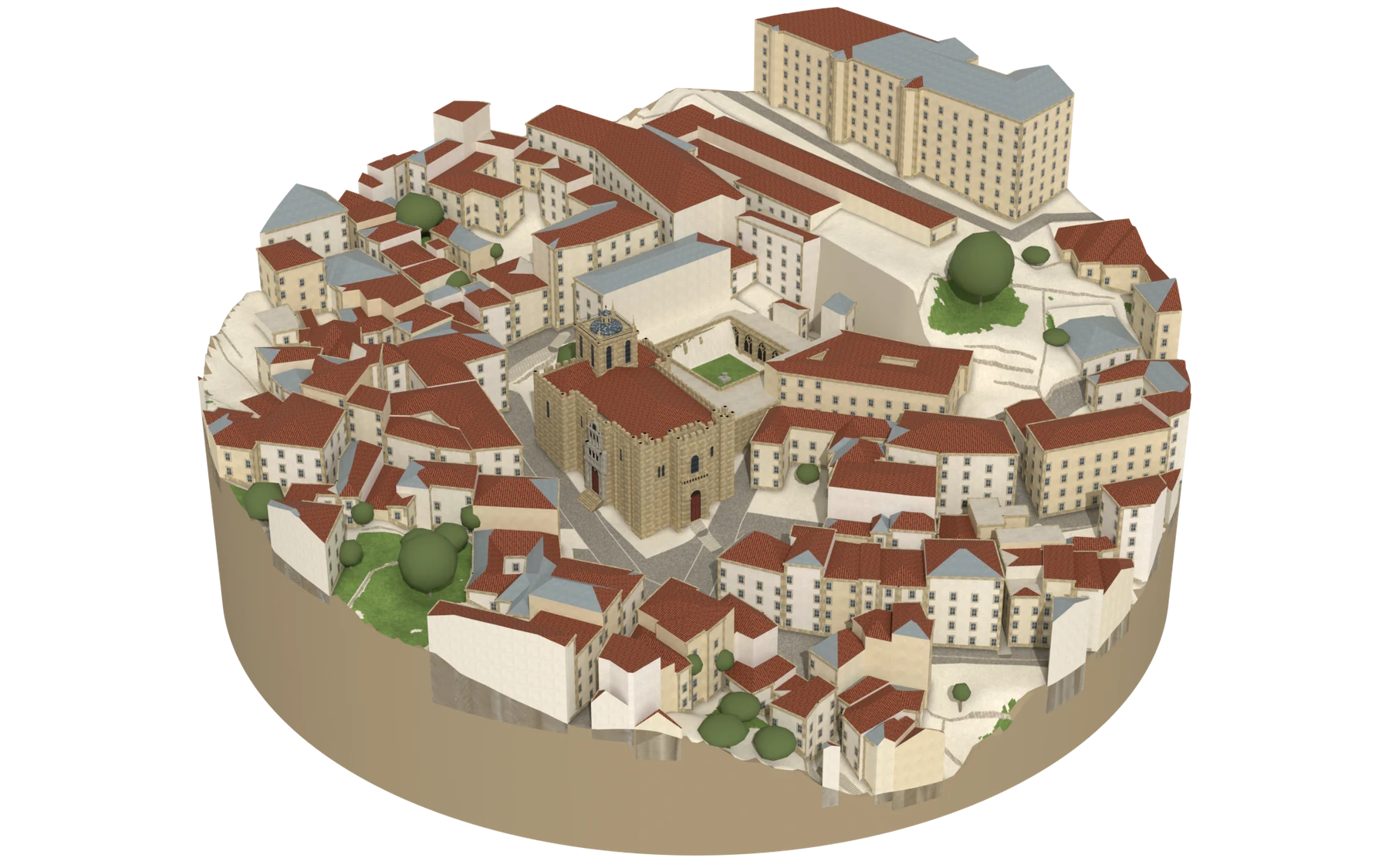
On the Praça 8 de Maio, the monastery where the first two kings of Portugal, D. Afonso Henriques and D. Sancho I, are buried. That is why it is a National Pantheon.
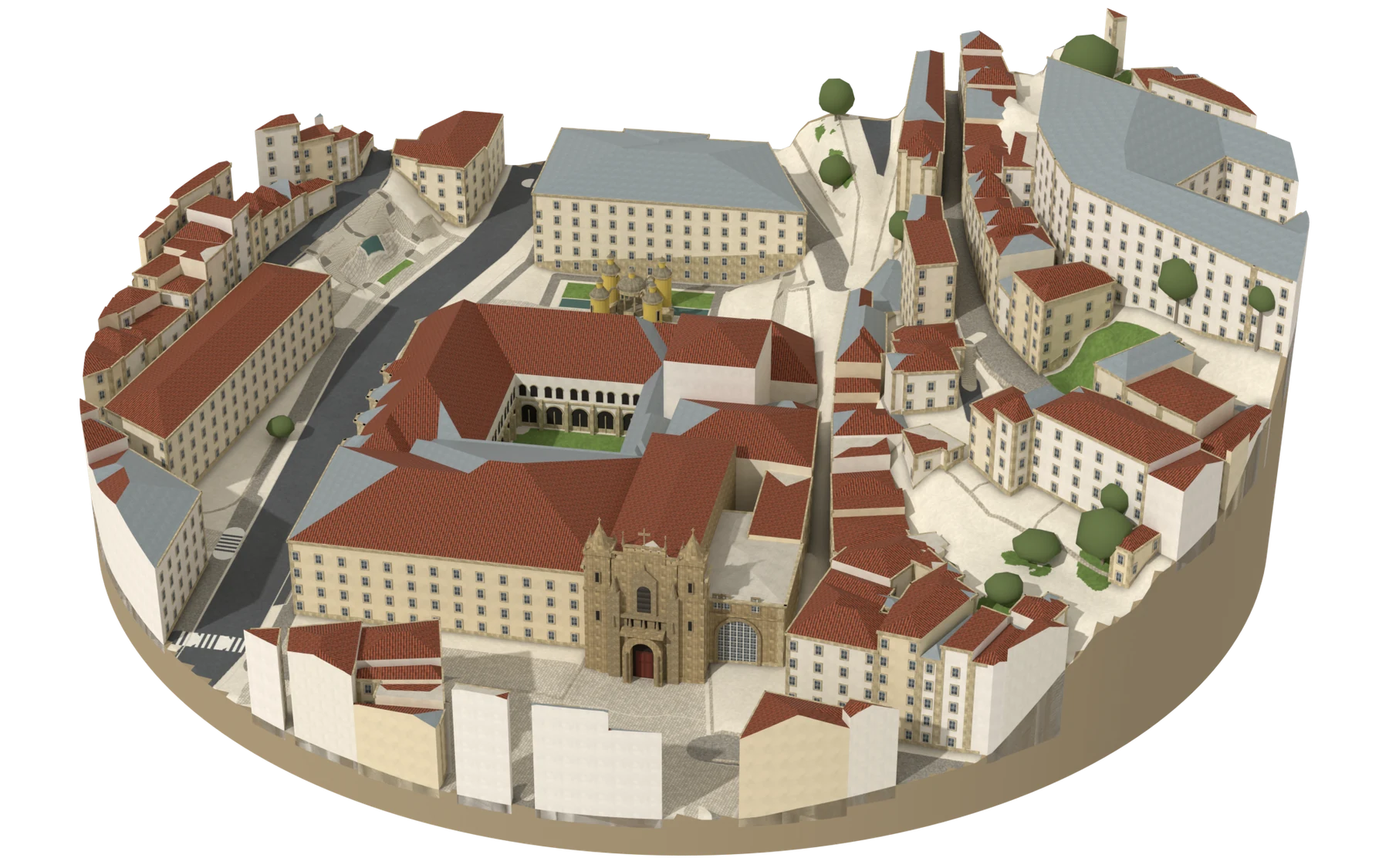
- façades and details: drawn from photographs
- tile or zinc, as in the aerial photograph
- streets, squares and gardens: drawn from the map
- tree
It dates from 1507–1513, the time of D. Manuel I, and follows the lines of the medieval frontage. The portal was added between 1522 and 1526, designed by Diogo de Castilho and carved by Nicolau Chanterene; the three figures above the door — the Virgin, a prophet and King David — are by João de Ruão. The arch in front dates from the early 19th century. It is 22 m from the ground to the top of the towers, without the spires.
A single nave, vaulted between 1507 and 1513, when Boytac was master of works. The walls have blue and white 18th-century tiles, made in Lisbon; on the left side is the pulpit that Nicolau Chanterene made in 1521. Above the entrance, the upper choir holds the choir stalls of 1512.
In the chancel lie D. Afonso Henriques and D. Sancho I. D. Manuel I did not find the old chests worthy of them and had these made; the recumbent effigies are by Nicolau Chanterene, and the tombs have been in this place since 1535. It is because of them that Santa Cruz is a National Pantheon.
Built between 1517 and 1522 over an earlier cloister, with the work directed by Marcos Pires. Five bays on each side and two storeys, the lower one vaulted; in the centre, the basin with a fountain, from 1639.
It stood in the middle of one of the three cloisters of the monastery. After the religious orders were abolished, one of the wings was demolished to straighten the street, and the fountain remained: the small temple in the centre and the four turrets in the water, designed by João de Ruão, with the stonework contracted in 1533. It is one of the first entirely Renaissance works made in Portugal.